Check out my previous newsletters below. If you haven't already, sign up for my newsletter!
Share
Why a Loaf Separates on the Side and the Top Lifts
Published 1 day ago • 2 min read
Hi Friends,
As promised, this is the follow-up to the email I sent a couple of weeks ago. Previously, we talked about why a loaf of bread collapses inward on the sides after it’s baked and removed from the pan. You can read it here.
Today, I’m exploring why the top of a home-baked loaf of bread lifts off—sometimes evenly, but more often just on one side, and sometimes quite dramatically.
1. The crust set too early. If the outside firms up before the inside finishes expanding, trapped steam and gas force the loaf to break at its weakest point—often lifting the top like a lid. Was the loaf baked too high in the oven?
2. The dough wasn’t shaped tightly enough—or was shaped too tightly. The sides and top won’t hold together under oven spring if the dough is rolled too loosely, so the loaf separates where tension was weakest. This is especially common in soft sandwich doughs. Shaping too tightly can also cause a split, particularly where the dough was stretched too thin.
3. Seam placement was weak or poorly positioned. A seam on the side—or a poorly sealed bottom seam—becomes a built-in escape hatch.
4. The dough was under-proofed. This is a big one. Under-proofed dough still has a lot of rising left to do. When it hits the oven, the crust can’t stretch fast enough. What looks like great oven spring goes awry when the loaf splits and you get a blowout.
5. No score (or ineffective scoring). Scoring isn’t decoration—it’s pressure management. If the loaf isn’t scored, or the score is too shallow or poorly placed, the dough will create its own exit.
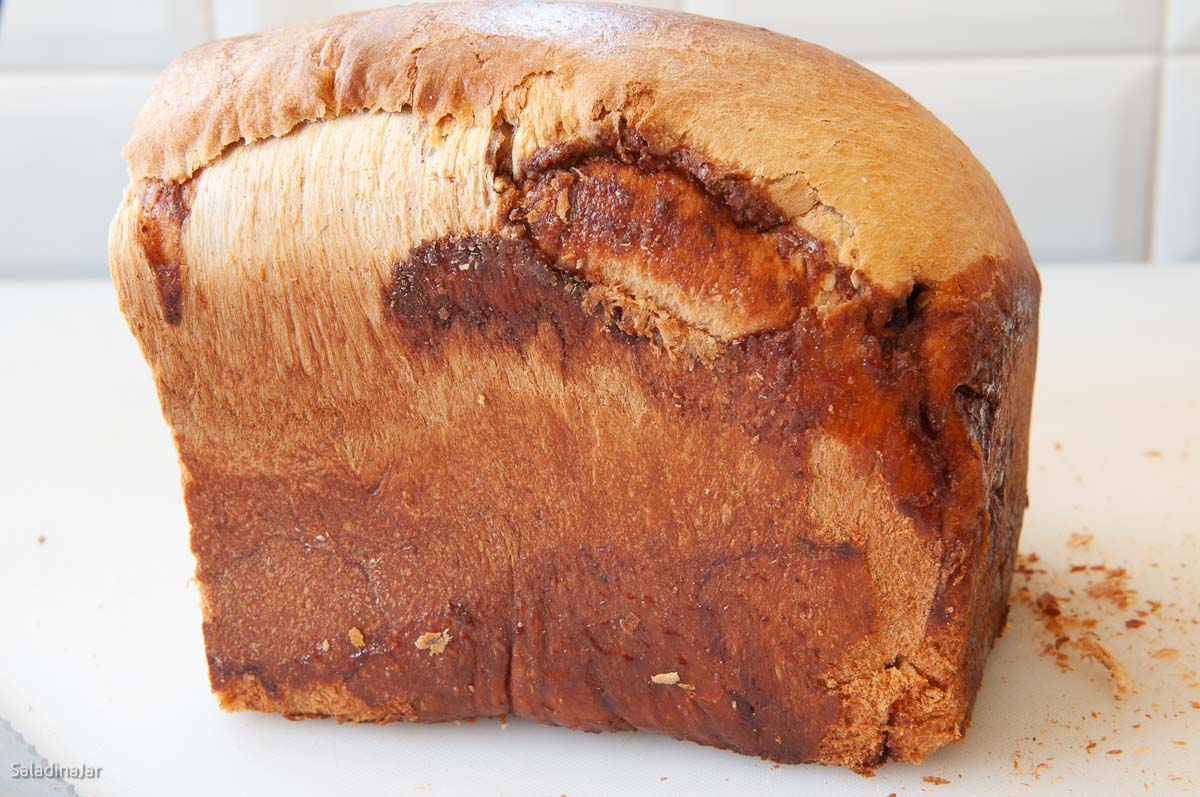
Now it's your turn. What is your best analysis about why these loaves split? I realize that since you didn't actually make these loaves, you can only guess about the proofing, shaping and baking. See my analysis in the "p.s." below.
This is another visual clue for the Cinnamon-Raisin Bread
How This Differs From Sides Collapsing Inward This kind of separation means:
The gluten structure was strong
Fermentation was still active
Expansion happened too forcefully or unevenly
In other words, this loaf had energy—not weakness. It just needed a better place to go.
I hope you found this helpful. If this happens to you, send me a picture, and I’ll be glad to help you troubleshoot.
Warmly,
Paula
Paula Rhodes | Home Economist
Food Worth Sharing
p.s. Exhibit A: My best guess is that the crust started to lift off this otherwise lovely Bread Machine Buttermilk Bread because of ineffective scoring. If you click over to that recipe, you'll see a picture of a loaf from the same recipe with a deeper, longer slash that likely prevented the top from lifting off.
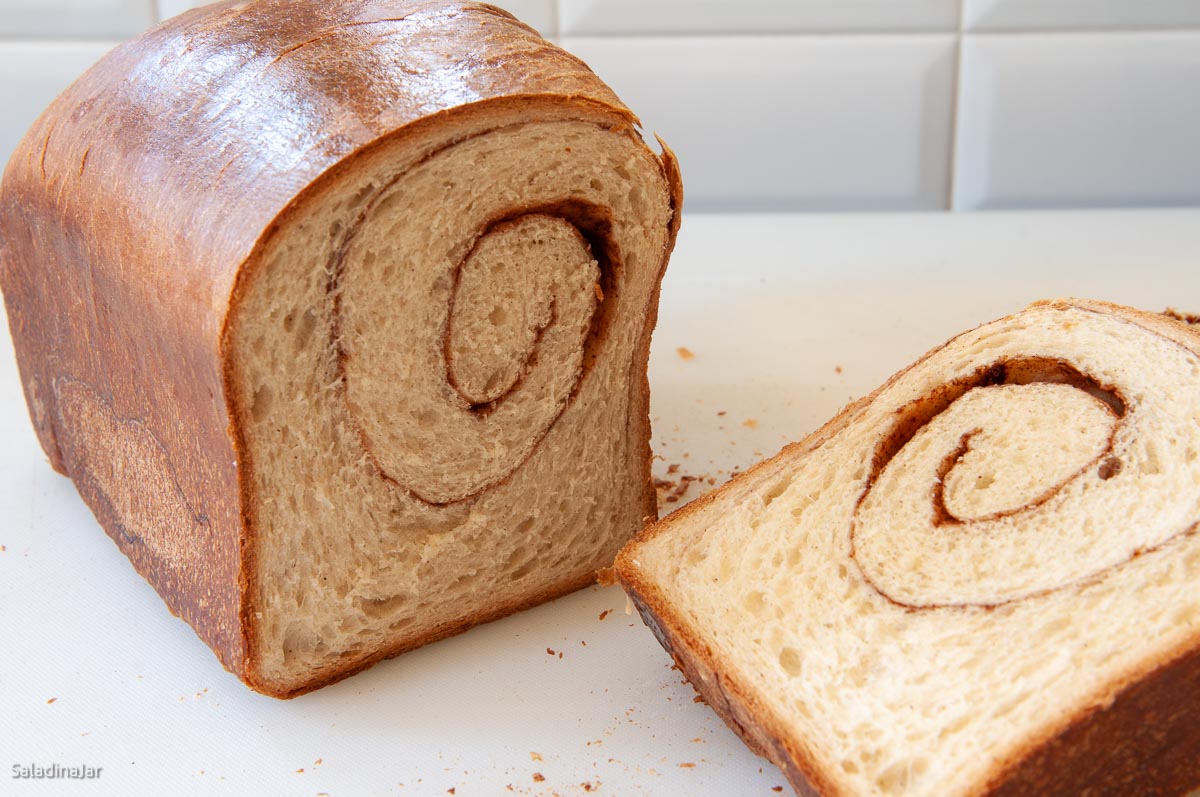
Exhibit B: I see a couple of possibilities here. This Bread Machine Cinnamon Raisin Bread was possibly underproofed. All that saved-up energy caused a split in its britches. The bottom picture shows a very thin area between the spiral and the crust where the dough was able to "bust out." Maybe I stretched the dough to ensure the loaf wouldn't have holes in the cinnamon spiral. The best solution for that is to use a Pullman pan. (a bread pan with a removable flat lid).
Do you agree with me or have a different idea?
You are receiving this email because you signed up for emails on the Salad in a Jar website. Unsubscribe | Update Your Interests | 4621 S. Cooper Ste 119, Arlington, TX 76017
Salad in a Jar
Homemade Food Worth Sharing
Check out my previous newsletters below. If you haven't already, sign up for my newsletter!
Hi Friends, I hope you had a wonderful holiday season and are ready to get serious about baking fantastic bread. Quick clarification before we dive into this tricky topic:I’m not talking about loaves that sink on top—that’s usually overproofing. Check out the right side where the loaf is starting to cave in. I’m talking about loaves that look fine out of the oven, then cave inward on the side as they cool. That kind of collapse almost always points to a structure problem, not fermentation....
No matter where you are on your bread-making journey, I’ve got a Christmas-morning-worthy recipe for you — whether you’re baking for brunch, snacks, or something sweet to nibble while the coffee brews. Beginning Bread Bakers Start Here: Easy Bread Machine Cinnamon Rolls with a Secret Ingredients A great make-ahead option for beginners. Mix the dough the day before and bake in the morning. The secret? A tiny pinch of cloves (optional) that adds warmth without shouting. Click to see the recipe...
Hi Friends, My mom was ahead of her time when she engaged in a little DIY aversion therapy with my pre-teen self. One day, I asked if I could make a full batch of Butterscotch Refrigerator Cookies purely to eat the dough. After a moment of hesitation, she said, “Go right ahead.” So I did… and I ate most of it right on the spot. Not surprisingly, I never made that recipe again. These days I stick to cookies I actually enjoy baked—one at a time, mostly 😉—like my Slice and Bake Coconut...